The Spouse Factor: Stop Relitigating 2022 in Every Meeting
How do you get action items from meeting transcript?
Record the conversation, then paste the transcript into ChatGPT, Claude, Gemini, or Copilot and ask it to list the decisions and who owns each one. Getting action items from meeting transcript takes about a minute, and Fireflies will do the recording and the summary in one pass if the meeting is on your calendar.
Why do business conversations with a spouse turn personal?
The professional and the personal share the same two humans, so “my partner made a bad call” and “this person doesn’t respect my judgment” arrive at the same time. Once the relationship enters the room, the business question stops getting answered.
Is it weird to record a meeting with your business partner?
The first two times, yes. By the third it’s just how the meeting starts, and most partners find they behave differently the moment the recorder is visible.
Record the conversation on your phone or on a dedicated recorder, then hand the transcript to an AI and ask for the decisions and the owners. Fireflies auto-joins scheduled calls and writes the summary itself. Otter records and transcribes live from a phone app for unplanned conversations. Plaud is a hardware recorder for in-person talks where a phone screen between you would be one more thing to resent.
Headed back to the showroom at 4:15 on a Tuesday. The AC is blasting and the cab of the truck feels very small. You and your partner, who is also your spouse, are coming back from a supplier meeting.
The new showroom display comes up. You think it’s worth the investment. They aren’t sure about the timing. It starts reasonably. You make your case, they make theirs.
Four minutes later you are not talking about the display. You’re talking about who has been carrying more of the load lately. Then the pricing decision from January that got made without full input. Then something from a KBIS two years ago that apparently is still open.
The display question is sitting right there, unanswered, and it stays unanswered, because you’re both too tangled up in everything else to decide anything.
Nobody in that truck is going to remember this conversation the same way next month, which is the argument for pulling action items from meeting transcript instead of from memory.
 Spotify
 Apple Podcasts
 Amazon Music
 YouTube
 Buzzsprout
 iHeartRadio
Why action items from meeting transcript beat two memories
The damage isn’t done by the big blowups. It’s the low-level disagreement that never quite resolves, the one that resurfaces every few months in a slightly different outfit.
Part of why it never resolves: you each remember the last round differently. So the next conversation opens with both of you already frustrated and already defensive, before anyone has said a word about the actual decision. (Insert the eyeroll and the “whatever” shrug here.)
What you need is a boundary you can point at. Something in the room that separates the two roles, so the business conversation gets to be a business conversation.
The switch that changes the room
Next time you sit down for a real strategic conversation with your familial business partner, whether it’s the display budget, a hiring decision, or how to handle a GC who is steamrolling you on site, hit record.
Pull out your phone or your recorder and say it out loud. “I want to capture this so we have a reference.” Then have the conversation.
Awkward? The first time, probably. Try it anyway and watch what changes.
What tends to happen is that you both behave differently while the tape is rolling. The physical presence of a recording moves you from married-couple-bickering into business-partners-solving-a-problem. You stay on topic. The tone stays professional. It is much harder to drift back to 2022 when you both know you’re on the record.
Getting action items from meeting transcript: what to use
Four tools cover almost every version of this conversation, and the one you want depends on where the conversation actually happens.
| Tool | Best for | Why |
|---|---|---|
| Fireflies | Recurring, scheduled partner meetings | Auto-joins calendar meetings, records, transcribes, and writes action items without anyone remembering to press anything |
| Otter | Unplanned, in-person conversations | Phone app records and transcribes live, with speaker recognition and automatic summaries |
| Plaud | The truck, the showroom floor | Hardware recorder built for in-person talks, so there’s no phone screen sitting between the two of you |
| ChatGPT, Claude, Gemini, Copilot | The summarizing step | Paste the transcript, ask for decisions and owners, get the neutral version back |
Fireflies and Otter both produce action items on their own. If you record on a device or a phone voice memo instead, getting action items from meeting transcript takes one more step, and that step is one sentence: summarize the action items and the advice from this conversation. FieryFX has a fuller rundown of the AI meeting note takers if you want to compare more of them before picking.
What do you say when you hit record?
“I want to capture this so we have a reference.” Said plainly, at the start, before the topic comes up. It lands as procedure rather than as an accusation.
Doesn’t recording make the conversation feel adversarial?
It reads that way if it appears mid-argument. Starting every strategic conversation the same way, calm ones included, makes it the format instead of a move.
What to ask for after the conversation ends
The transcript on its own is a wall of text neither of you will reread. The summary is the part that does the work, and action items from meeting transcript are what you’re actually after.
Ask the AI for the decisions and who owns each one. What comes back is the neutral, unfeeling version of what was said while you were both focused on the problem instead of on each other. It doesn’t editorialize about tone. It doesn’t remember that somebody sighed.
That document is the closest thing there is to a C.Y.A. for your relationship.
Not sure which part of your operation is quietly costing you the most right now? The Sales Superpower Quiz takes about two minutes and shows you where you’re most exposed.
Check the action items from meeting transcript instead of arguing
There will be a disagreement about what was decided. That’s not pessimism, it’s just how two people and one conversation work.
When it comes, you don’t have to argue about whose memory is right. You pull up the action items from meeting transcript and read what you both said. The argument that used to take a whole evening takes forty seconds, and neither of you has to be wrong about your own recollection, because recollection stopped being the evidence.
Brandy covers the recording side of this in her NKBA webinar on AI note-taking for client meetings, including how to handle recording in rooms that aren’t quiet.
Which recorder works for a two-person conversation in a truck?
A hardware recorder like Plaud, or a phone voice memo if you’d rather not buy anything. Both handle a cab better than a laptop, and neither one puts a screen between you.
Can AI pull the decisions out without either of you re-arguing them?
That’s the point of the summarizing step. It reports what was said, so the two of you can disagree with a decision on its merits instead of disagreeing about whether it happened.
The record is for both of you
The thing that surprises most partners who try this is that the recording protects the person who was worried about it.
If you’ve ever finished a conversation thinking you conceded more than you meant to, action items from meeting transcript settle that too. It works in both directions, which is what makes it a boundary instead of a weapon. And if the isolation underneath all of this sounds familiar, that’s its own conversation.
Start with the next strategic conversation on your calendar. One sentence, one recording, one set of action items from meeting transcript. The display question finally gets answered, and 2022 stays in 2022.
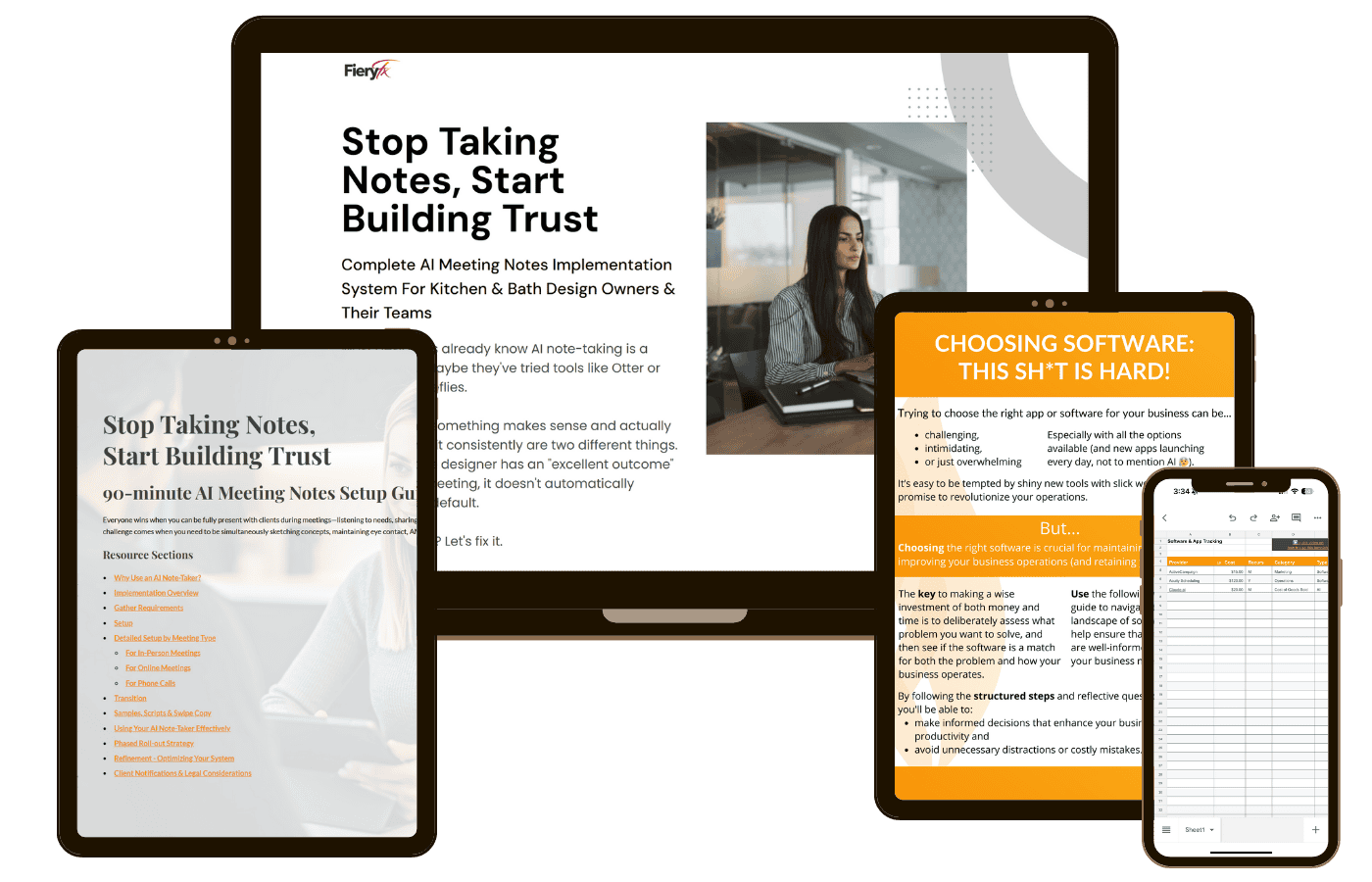
Ready to stop relitigating 2022 in the truck? The AI Meeting Notes Implementation Guide has the setup, the prompts, and the workflow, so you don’t have to figure out the AI part on top of everything else. Get the guide here.
Want to explore more ways AI can transform your business operations? Subscribe to the Elevated podcast for practical insights on leveraging technology and systems for business growth. New episodes provide actionable strategies you can implement immediately.
Prefer video content? Subscribe to our YouTube channel where we break down complex AI applications into clear, step-by-step guidance.
About the Author: Brandy Lawson is a speaker, author, and the founder & CEO of FieryFX, where she helps luxury design businesses put AI to work. She hosts the Elevated podcast, wrote High-er Help, and starts every AI conversation in one place: the meetings where everything gets decided and nothing gets written down.