Mental Load Business Owner: Simple Ritual that Finally Lets you Leave

What is the mental load business owner problem?
The mental load business owner carries home isn’t about working too much. It’s about being the only storage system for the work. When your head is the only place project details live, your brain can’t stop holding on, even when you’re sitting at the dinner table.
Why can’t business owners stop thinking about work when they get home?
There’s a psychological principle called the Zeigarnik effect: unfinished tasks stay active in working memory until they’re resolved or recorded. Your brain loops the client conversation from this afternoon because it knows the information isn’t safe yet. It won’t let you relax until it has a backup.
Is it normal to mentally replay client conversations after hours?
Completely normal, and almost universal among design business owners. It’s not anxiety or burnout. It’s your brain doing exactly what it was designed to do: protect information it knows has no backup. The fix isn’t willpower. It’s giving your brain somewhere else to put it.
Your tires hit the driveway at 6:15.
Dinner is on. You can smell it as you pull into the garage. You walk through the door and your family lights up, because you’re home early, and that almost never happens anymore.
You sit down at the table. You ask how everyone’s day was. You listen.
But in the background you’re replaying the conversation with Mrs. Jones from this afternoon. Did you sound too harsh when you pushed back on the timeline? Did she say the backsplash tile was backordered, or was it the hardware? You should have written that down. It’s probably written down somewhere. It’s probably fine.
It’s probably fine.
The mental load business owner carries home isn’t a sign of dedication. It’s a sign that your brain is the only backup for everything that happened today, and it knows it.
 Spotify
 Apple Podcasts
 Amazon Music
 YouTube
 Buzzsprout
 iHeartRadio
The mental load business owner carries has a name
Your brain isn’t doing this to punish you. It’s trying to help.
There’s a psychological principle called the Zeigarnik effect: unfinished tasks stay active in working memory until they’re resolved or recorded. Your brain is looping the Mrs. Jones conversation because it knows that information isn’t safe yet. There’s no backup. If you relax, it might be gone by morning. So it won’t let you relax.
This is cognitive overload, not from too much work, but from being the only storage system for the work. When your head is the filing cabinet, your head never gets to rest.
The myth of the dedicated business owner is that the ones who care most are the ones who can’t stop thinking about work. But caring about your business and being present for your life are not a trade-off. That belief is a fallacy, and it’s costing you more than just dinner.
What is cognitive offloading and how does it help business owners?
Cognitive offloading is the practice of moving information from your head into a reliable external system. When your brain knows the details are safe somewhere other than your skull, the Zeigarnik loop stops. It’s not a productivity strategy. It’s permission to actually leave work at work.
How long does the end-of-day wind-down ritual actually take?
Two minutes. You open the app, confirm the day’s recordings are uploaded and transcribed, do a ten-second scan to verify the key details are captured, and close the app. That’s the whole ritual. Your brain has been waiting all afternoon for that signal.
How to reduce the mental load business owner carries home
The fix is cognitive offloading, and it’s simpler than it sounds.
Before you leave the office, before you get in the car, you check that the recordings from the day are uploaded and transcribed. That’s it. That’s the ritual. That’s the hat you hang at the door.
Here’s what it looks like in practice. You open the app. You confirm the Mrs. Jones meeting is in the transcript. You do a ten-second scan to verify the key details are there. Backsplash tile: backordered, four-week lead time. Hardware: on order, confirmed. You close the app.
Your brain has been waiting all afternoon for that signal. When it gets it, when it knows the information is safe somewhere other than your skull, it can finally stop holding on.
You get in the car. You drive home. You walk through the door.
And this time, when your family lights up, you’re actually there.
The American Psychological Association’s research on cognitive load consistently shows that the act of recording information, not just intending to record it, is what triggers the mental release. The Zeigarnik loop doesn’t close on promises. It closes on proof. Your brain needs to see the backup, not just know it exists.
This is why the end-of-day review matters as a ritual, not just a task. It’s the signal your brain has been waiting for all day.
The mental load business owner carries is a documentation problem
Most advice about work-life balance focuses on boundaries: stop checking email after 6, set office hours, protect your personal time. That advice isn’t wrong, but it doesn’t address why the boundary keeps failing.
The boundary fails because your brain doesn’t respect it. Your brain knows the Mrs. Jones details aren’t safe. It knows the backsplash tile question is still open. It knows you’re the only copy of everything that happened today. And it will keep looping until that changes, regardless of what time it is or where you’re sitting.
The mental load business owner carries home isn’t a discipline problem. It’s a documentation problem. And the fix isn’t a better evening routine. It’s a two-minute end-of-day ritual that gives your brain the backup it needs to finally let go.
Not sure where your current systems are leaving your brain most overloaded? The Sales Superpower Quiz takes about two minutes and shows you exactly where your process is costing you the most, including where the mental load is quietly building up every day.
What should the end-of-day review actually include?
Open your recording app and confirm the day’s meetings are uploaded and transcribed. Scan each transcript for the two or three details that were still open when you left the meeting. Verify they’re captured accurately. Close the app. That’s it. The goal isn’t a full review. It’s a confirmation that the information is safe, which is the only signal your brain actually needs.
How do AI meeting notes reduce the mental load for business owners?
They move the storage job from your brain to a searchable system. When every client conversation, vendor call, and project decision is captured automatically, your brain stops being the only backup. The Zeigarnik loop closes because the information is genuinely safe, not just probably fine. That’s what lets you walk through the door and actually be home.
Two minutes. Every day. That’s the whole system.
The mental load business owner carries home isn’t inevitable. It’s a symptom of a brain doing its job without the tools it needs to hand off the work.
Give it a backup it can trust, and it can finally relax. Not because you worked less or cared less, but because the information is safe and your brain knows it.
Your tires hit the driveway. Dinner is on. Your family lights up.
This time, you’re actually there.
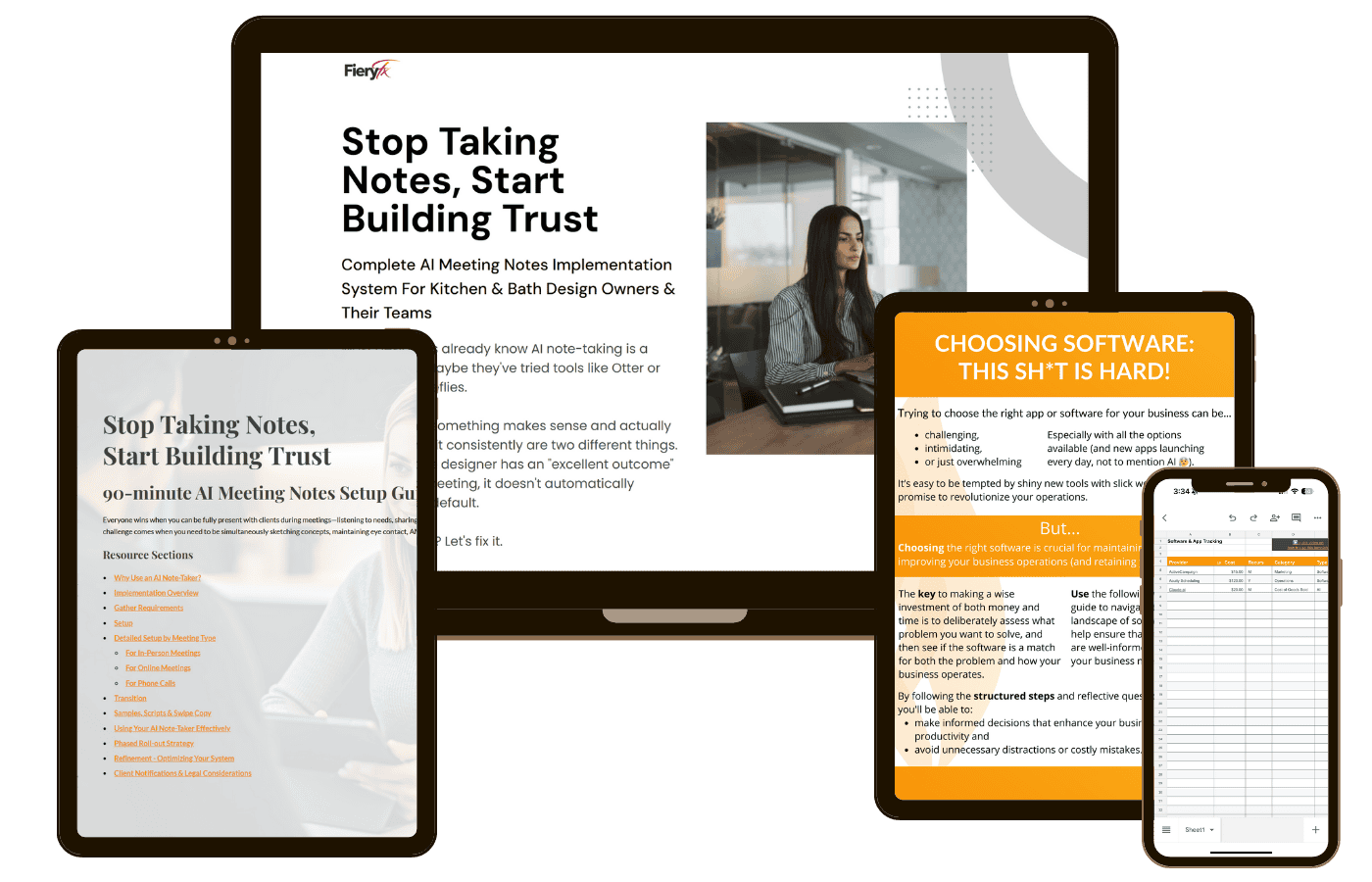
Ready to leave work at work? The AI Meeting Notes Implementation Guide includes the end-of-day workflow, not just how to record, but how to review and close out the day so your brain has actual permission to stop. Get the guide here.
Want to explore more ways AI can transform your business operations? Subscribe to the Elevated podcast for practical insights on leveraging technology and systems for business growth. New episodes provide actionable strategies you can implement immediately.
Prefer video content? Subscribe to our YouTube channel where we break down complex AI applications into clear, step-by-step guidance.
About the Author: Brandy Lawson is a speaker, author, and the founder & CEO of FieryFX, where she helps luxury design businesses put AI to work. She hosts the Elevated podcast, wrote High-er Help, and starts every AI conversation in one place: the meetings where everything gets decided and nothing gets written down.