Master AI Information Capture: 3 Real Scenarios That Transform Your Workflow
Welcome! You’ve tuned into another episode of Elevated, the podcast helping you build a better Kitchen & Bath Design business through innovation and modernization. I’m your host, Brandy Lawson, and in this episode we’re talking all things information capture and exchange—how to reduce friction when gathering data from various sources and formats using AI.
What is AI information capture and why does it matter?
AI information capture transforms how you gather, store, and share information by converting any format—handwritten notes, photos, voice recordings—into searchable, shareable digital data. This eliminates the friction of transposing information manually and ensures no valuable insight gets lost or becomes inaccessible.
Can AI really read my handwritten notes and extract text from photos?
Yes. Modern AI tools can accurately convert handwritten text into digital format and extract information from photos—including measurements scribbled on scraps of paper. This combines the cognitive benefits of handwriting with the accessibility and utility of digital systems.
What’s the biggest advantage of AI information capture?
AI information capture respects how humans naturally process information (handwriting, speaking) while making that data searchable, transferable, and integrable into organized digital systems. You no longer have to choose between authentic capture methods and digital accessibility.
Do you ever struggle to keep up with the whirlwind of thoughts, ideas, and notes that hit you throughout your workday? The conference insights scribbled in notebooks that never get transcribed. The measurements written on scraps of paper that barely survive the trip back to the office. The brilliant client follow-up thoughts you have driving home that evaporate before you can write them down.
Keeping everything organized and accessible while making it feel easy is genuinely challenging. Traditional methods force you to choose between natural information capture (handwriting, speaking) and digital accessibility (searchable, shareable).
AI information capture eliminates this compromise entirely.
Why Does AI Information Capture Transform Workflows?
Our brains are wired for stories and natural expression. Handwriting helps us process and retain information. Speaking allows us to capture authentic thoughts without the barrier of typing. Photos preserve visual information instantly.
These organic capture methods have always been powerful. The problem? They weren’t searchable, shareable, or easily integrated into digital workflows.
AI information capture bridges this gap. Now you can capture information in whatever format feels most natural in the moment, then transform it into digital data ready for action—all without manual transcription or data entry.
What Does AI Information Capture Look Like in Real Scenarios?
Instead of listing abstract capabilities, let’s explore three specific scenarios where AI information capture dramatically reduces friction and improves outcomes.
Scenario 1: Taking Notes at a Conference
Imagine you’re at a conference, soaking up invaluable insights from industry leaders. Traditionally, you’d jot down notes in your notebook, only to later face the tedious task of transposing them into your digital system.
Who are we kidding? Those notes got chucked in your bag and ended up at the bottom of the pile on your desk. Maybe you’ll see them again next year when you break out the notebook for the next conference.
How AI Information Capture Solves This
Your conference notes can be revived without additional effort using digital handwriting tools with AI-powered text extraction.
The Process:
Apps like Noteshelf 3 on iPad allow you to handwrite notes digitally during sessions. The experience feels identical to traditional note-taking—you’re still processing information through handwriting, which helps your brain retain insights.
The difference comes afterward. Simply export your handwritten notes as text into a summary document. This seamlessly shareable document makes it easy to distribute insights to your team, keeping everyone informed without losing the power of personalization that handwritten notes offer.
Why This Matters:
Handwritten notes haven’t gone the way of the dinosaurs because they genuinely help the brain process and retain information. AI information capture combines that organic processing with the accessibility and utility of digital systems. You get the best of both approaches.
Scenario 2: You Forgot Everything
We’ve all experienced this nightmare: arriving at a project site to take measurements, only to discover you’ve forgotten everything except your measuring tape. You scribble numbers on a scrap piece of paper, praying it stays in your pocket long enough to get back to the office.
Even if the paper survives, someone still needs to manually enter those measurements into project drawings—a task that’s tedious, error-prone, and easy to procrastinate on.
How AI Information Capture Solves This
You can salvage this situation with remarkable ease using AI-powered image text extraction.
The Process:
Once you’re back at your phone, snap a quick photo of your handwritten measurements. Send that photo to your team through your preferred communication channel.
Team members can use AI tools to extract the vital information directly from the image and enter it into project drawings. The measurements transfer from scrap paper to digital system in minutes, not hours or days.
Why This Matters:
AI information capture eliminates the barrier between field work and office systems. Information flows seamlessly regardless of how it was initially captured. The urgency of manual transcription disappears, allowing teams to process field data quickly and accurately.
Scenario 3: Taking Communication Off the Page
Post-client meetings, translating spoken thoughts into written words can feel like a chore. You have brilliant insights about the project, clear next steps in mind, and important details to share with your team—but the thought of sitting down to type everything out creates procrastination.
How AI Information Capture Solves This
Record voice memos during your drive back or in a quiet moment afterward, then let AI handle the transcription.
The Process:
Voice memos allow you to capture your thinking authentically without the friction of typing. Services like Otter.ai transcribe these recordings automatically. You can then copy and paste the transcript into the project file or send it directly to your team.
Why This Matters:
FieryFX founder Brandy Lawson has personally found that typing during client meetings creates a barrier to connection. Having a computer in front of her and tapping on the keyboard detracts from full presence in the conversation.
Her solution? She transitioned to using Noteshelf 3 on iPad for client meetings. Handwriting notes keeps the interaction human while the ability to easily export and search these notes digitally streamlines workflow. She maintains efficiency without sacrificing rapport.
When it comes to creating the Elevated podcast itself, most episodes get started with the walking, talking, and recording method using Otter.ai. This approach allows free movement and thinking, capturing every thought to later refine into final episode scripts.
Voice-based AI information capture respects how we naturally process ideas while making those ideas immediately actionable.
What Makes AI Information Capture Different from Traditional Methods?
Traditional information capture forces compromises:
- Handwrite notes → benefit your memory but create transcription burden
- Type notes → immediately digital but interferes with presence and retention
- Take photos → capture visual information but requires manual data extraction
- Record audio → preserve exact words but difficult to search or reference later
AI information capture eliminates these trade-offs entirely.
Handwriting and verbal expression truly align with how we process and retain information. It’s a core part of our humanness and how we connect. Thanks to AI, we can now make this data searchable and transferable, integrating it into organized systems with ease.
By capturing the nuances of our thoughts and literal handwritten words, AI information capture ensures no valuable insight goes unrecorded or inaccessible.
What Tools Enable AI Information Capture?
Several excellent tools support different AI information capture needs:
For Digital Handwriting:
- Noteshelf 3 (iPad) – Handwrite notes with AI-powered text extraction
- GoodNotes (iPad) – Alternative digital handwriting app with OCR capabilities
For Voice Recording and Transcription:
- Otter.ai – Automatic transcription of voice memos and meetings
- Voxer – Quick team communication with transcription capabilities
For Photo Text Extraction:
- Google Lens – Extract text from any photo using your phone
- Microsoft Office Lens – Capture and convert images to editable documents
For direct links to these AI information capture tools and additional resources, visit fieryfx.com/resources.
FAQ: Getting Started with AI Information Capture
Which AI information capture tool should I start with?
Start with the capture method you use most frequently. If you take lots of handwritten notes, begin with a digital handwriting app like Noteshelf 3. If you process thoughts verbally, try Otter.ai for voice transcription. If you photograph documents or measurements regularly, explore Google Lens for text extraction.
Do I need special equipment for AI information capture?
Most AI information capture tools work with standard devices you likely already own. A smartphone enables photo and voice capture. An iPad with Apple Pencil enhances the digital handwriting experience but isn’t mandatory. Start with what you have and invest in specialized tools only if specific capture methods become central to your workflow.
How accurate is AI at reading handwriting or extracting text from photos?
Accuracy has improved dramatically and continues advancing. Legible handwriting typically converts with 90%+ accuracy. Photo text extraction works remarkably well with clear images. Always review AI-extracted content for accuracy, but expect minimal corrections rather than complete rewrites.
Will AI information capture work with my existing systems?
Yes. AI information capture tools export to standard formats (text, PDF, images) that integrate with virtually any system. The extracted information becomes regular digital data you can paste into project management tools, email, documents, or any other platform you use.
FAQ: Common AI Information Capture Challenges
What if I forget to export or transcribe captured information?
Build the export/transcription step into your immediate workflow rather than treating it as a separate task. For example, export handwritten notes before leaving the conference venue, transcribe voice memos during the same drive when recorded, or extract photo text immediately after capturing the image. Making it immediate prevents the backlog that creates overwhelm.
u003cstrongu003eHow do I organize all this captured information?u003c/strongu003e
Establish clear rules about where different types of information belong in your systems. Meeting notes might go directly into your project management tool. Conference insights could feed into a shared knowledge base. Field measurements transfer to project drawings. AI information capture makes the transfer easy; your system organization determines where things land.
What if my handwriting is terrible?
AI handwriting recognition continues improving, but if accuracy is consistently problematic, voice capture might be a better option for you. The goal is finding capture methods that match your natural working style while providing acceptable accuracy. Experiment with different approaches to find what works best.
Can I use AI information capture for sensitive or confidential information?
Exercise appropriate caution with any digital tool. Review the privacy policies of AI information capture services you use. For highly sensitive information, consider tools that offer encryption and don’t store data on external servers, or capture information using methods that keep it entirely within your controlled systems.
FAQ: Advanced AI Information Capture Strategies
How can I use AI information capture for team collaboration?
Create shared protocols for how team members capture and transfer information. For example, field measurements always get photographed and shared in the project channel. Client follow-up thoughts always get voice recorded and transcribed into the CRM. Consistent practices ensure information flows reliably across your team.
Can AI information capture integrate with project management systems?
Many project management platforms offer integrations with AI information capture tools, or you can manually paste extracted text into project records. The key is establishing clear processes for how captured information flows into your systems rather than creating disconnected information silos.
How do I train my team on AI information capture?
Start by demonstrating specific scenarios where AI information capture solves real problems they experience. Provide hands-on practice with the tools during team meetings. Share success stories as team members discover workflows that work for them. Adult learning happens best through relevant application rather than abstract instruction.
What’s the return on investment for AI information capture tools?
Calculate time currently spent on manual transcription, searching for lost notes, or recreating information that wasn’t properly captured. Most AI information capture tools cost $10-30 per month per user. If they save even 2-3 hours monthly, they’ve more than justified their cost—and the actual time savings is typically much higher.
How Can You Start Using AI Information Capture This Week?
AI information capture opens countless possibilities for reducing friction in how you gather and share information. Every format—handwriting, photos, voice memos—can now flow seamlessly into different formats, ready for action.
Take a moment this week to explore where these AI-driven techniques could make a difference in your business operations:
Identify Your Information Capture Pain Points:
- Where do you currently lose information?
- What manual transcription tasks do you avoid or delay?
- Which capture methods feel natural but aren’t digitally accessible?
Choose One Scenario to Experiment With:
- Conference or training notes that need sharing
- Field measurements or site observations
- Post-meeting thoughts or client follow-ups
- Quick ideas that occur during non-work moments
Select an Appropriate AI Information Capture Tool:
- Match the tool to your primary capture method
- Start with free or low-cost options to test before investing
- Ensure the tool integrates reasonably with your existing systems
Test the Workflow End-to-End:
- Capture information using the AI tool
- Extract or transcribe the content
- Transfer it into your working systems
- Evaluate time saved and quality of results
The opportunity for transformation is as vast as your imagination.
Connecting AI Information Capture with Comprehensive AI Strategy
AI information capture represents one component of a broader operational efficiency strategy. When you combine effective information capture with AI-powered meeting documentation, task management, and client communication, the efficiency gains multiply exponentially.
Consider this integrated workflow: AI captures detailed meeting notes during your client consultation. Those notes automatically transcribe and transfer into your project management system. Field measurements photographed on-site extract directly into design drawings. Voice memo follow-up thoughts transcribe into client communication drafts.
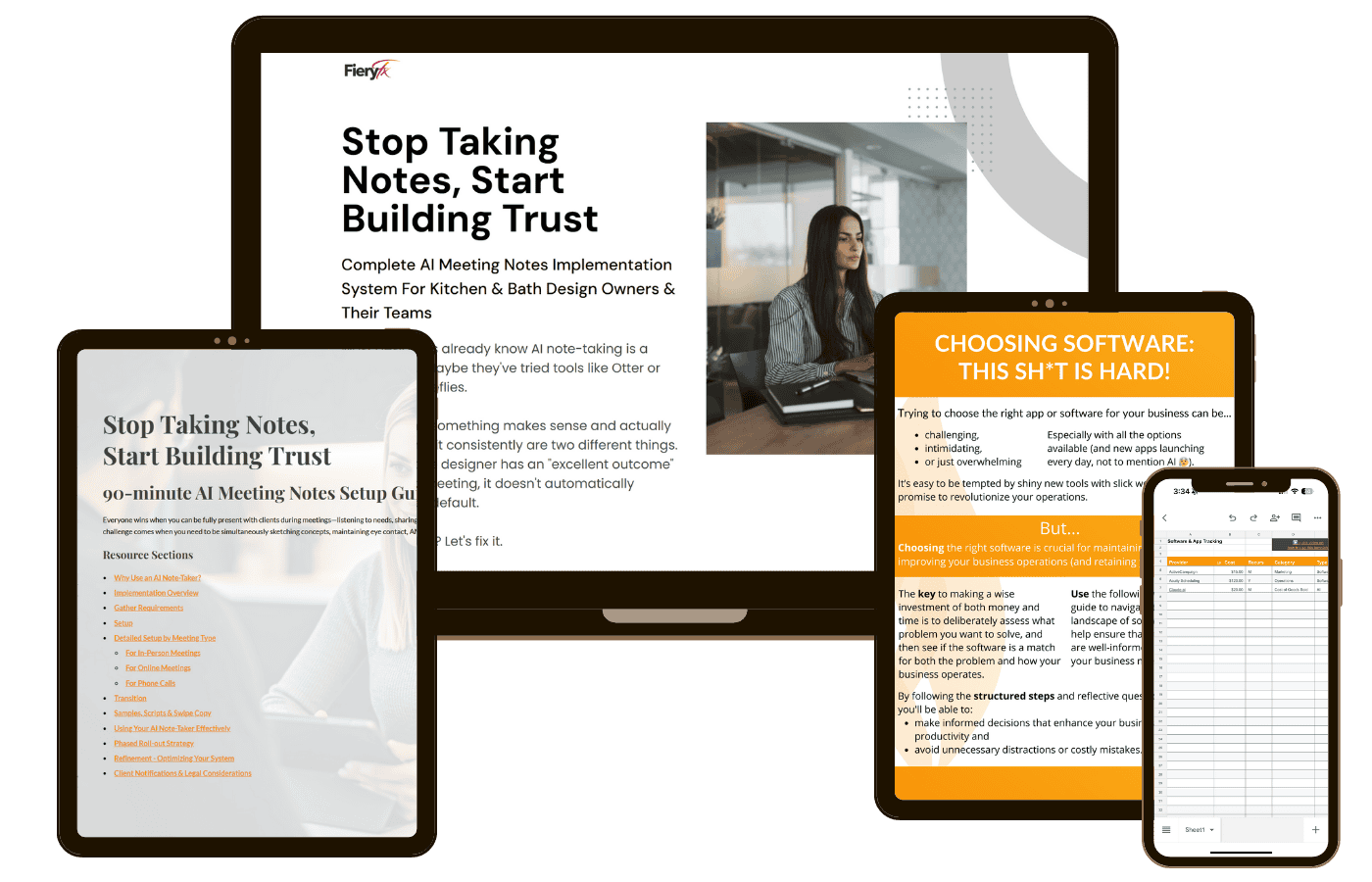
Our AI Meeting Notes Implementation Guide provides comprehensive frameworks for adopting AI-powered documentation systems that complement your information capture strategy. When these tools work together, you create seamless operational environments where information flows effortlessly from capture to action.
Ready to Transform How You Capture Information?
AI information capture eliminates the friction between how you naturally work and how your systems need information. No more choosing between authentic capture methods and digital accessibility. No more manual transcription creating bottlenecks. No more lost insights or inaccessible data.
The technology exists. The tools are accessible and affordable. The only requirement is willingness to experiment with new workflows that respect your humanity while leveraging AI capabilities.
Ready to explore how AI can transform your entire business systems strategy? Book a Sales Health System Check call to discuss your specific challenges and opportunities. Our team can help you identify where AI information capture and other strategic improvements will create the biggest impact for your business.
Whether you’re just beginning to explore AI tools or looking to integrate multiple AI capabilities into cohesive workflows, starting with AI information capture provides immediate value while building foundation for more comprehensive transformation.
Want to explore more ways AI can transform your business operations? Subscribe to the Elevated podcast for practical insights on leveraging technology and systems for business growth. New episodes provide actionable strategies you can implement immediately.
Prefer video content? Subscribe to our YouTube channel where we break down complex AI applications into clear, step-by-step guidance.