CRM Email Integration Guide: From Scattered Emails to Centralized Intelligence
u003cstrongu003eWhat is CRM email integration and why does it matter?u003c/strongu003e
CRM email integration brings all your communications with prospects, leads, and clients into one centralized hub within your sales system. Instead of jumping between different apps to track conversations, you have a command center where your entire team can access complete interaction history—eliminating missed information and wasted time.
Will CRM email integration put all my personal emails in the system?
No. Modern CRM email integration systems are sophisticated enough to let you control exactly which emails get captured. You can choose automatic capture for all sales-related emails, manual selection per email, or set rules to always include (or exclude) specific email addresses.
How does CRM email integration improve the client experience?
When client communications are centralized and accessible to your entire team, anyone can step in to help without playing catch-up. Clients don’t have to repeat information, wait for specific team members to return, or experience gaps in service. The result is seamless, professional interactions that build trust.
Picture this: You’re managing multiple client conversations. You’re sending emails about project details. Texting about scheduling. Maybe sliding into Instagram DMs to share design inspiration. Each conversation lives in a different app, a different inbox, a different platform.
Then a client asks a simple question: “What did we decide about the cabinet hardware?”
You freeze. Was that conversation in email? Text? That video call two weeks ago? Which team member was involved? Where did that information end up?
This scenario plays out daily in kitchen and bath design businesses that haven’t implemented CRM email integration. The cost? Wasted time, frustrated clients, and team members who can’t find critical information when they need it most.
What Is CRM Email Integration?
CRM email integration connects your email communications directly to your customer relationship management system, creating a centralized hub for all client interactions.
Think of it as upgrading from scattered sticky notes to a command center that captures, organizes, and makes accessible every conversation with prospects and clients.
Beyond Just Email
Modern CRM email integration doesn’t stop at email. These systems can gather communications from various channels:
- Email conversations (obviously)
- Text messages
- Social media DMs (Instagram, Facebook, LinkedIn)
- Phone call logs
- Meeting notes
No more jumping between different apps or platforms to figure out where a conversation ended up. Everything flows into one accessible location.
Why Does CRM Email Integration Transform Sales Processes?
The problem with scattered communications isn’t just inconvenience—it’s the compounding effect of missed context, duplicated effort, and broken client experiences.
The Scattered Information Problem
Without CRM email integration, your sales process looks something like this:
A prospect reaches out expressing interest in your kitchen design services. You exchange several emails providing project details and discussing budget expectations. The designer has some of this information in their inbox. The project manager has other pieces. The sales rep maintains yet another partial thread.
When the prospect follows up with questions, no one person has the complete picture. Team members waste time asking each other “What’s happening with this account?” or worse—they give the client conflicting information because they’re working from different conversation fragments.
The Centralized Intelligence Solution
Now imagine the same scenario with CRM email integration in place:
The prospect’s initial inquiry automatically captures in your sales system. Every subsequent email, text, or message adds to this centralized record. The entire team accesses this hub and immediately sees the full history—the initial inquiry, project details, budget discussions, design preferences, and timeline expectations.
Everyone operates from the same information without exchanging a single internal email. No missed details. No duplicated efforts. No wasted time searching for context.
The result: Your team knows exactly where to find what they need, and clients experience seamless communication regardless of who they interact with.
How Do You Set Up CRM Email Integration?
The setup process is more straightforward than most business owners expect. Here’s the systematic approach:
Step 1: Establish the Connection
Modern CRM platforms guide you through connecting your email provider:
For cloud-based CRMs (like HubSpot or Zoho): The system walks you through authorization to connect with your email provider—typically Google Workspace or Office 365. This connection allows bi-directional sync: emails flow into the CRM, and you can send emails from within the CRM that also appear in your regular email.
For inbox-integrated CRMs (like Streak): These systems live directly in your inbox as browser extensions. Setup primarily involves deciding who on your team has access to shared information.
For direct links to these CRM email integration tools and comparison information, visit fieryfx.com/resources.
Step 2: Decide Your Capture Settings
This is where you gain control over what information enters your system. You have options:
Automatic Capture: All emails automatically sync to your CRM. This works well if 80%+ of your work involves sales-related communications—for example, during heavy sales cycles or when your primary role is business development.
Manual Selection: You choose per email what gets captured by using a simple BCC address or clicking a button. This approach suits roles where sales emails represent less than 50% of your communications—such as CEO positions juggling multiple responsibilities.
Rule-Based Capture: Set sophisticated logic for automatic decisions:
- Always capture emails to/from specific client email addresses
- Always exclude certain addresses (like your lawyer or accountant)
- Capture only emails with specific subject line patterns
- Include or exclude based on sender domain
The beauty of CRM email integration settings? They’re not permanent. As your role evolves, adjust the settings to match your current needs.
Step 3: Leverage Your Consolidated Data
Once CRM email integration is active, the real power emerges:
Complete Conversation History: See every interaction with a prospect or client in chronological order, regardless of which team member was involved.
Status Management: Change lead statuses, update pipeline stages, and track progress without leaving the email conversation.
Smart Reminders: Set follow-up reminders directly from emails so critical conversations never fall through cracks.
Engagement Tracking: Know when prospects open emails, click links, or engage with your content. This intelligence helps you time follow-ups perfectly.
Team Collaboration: Leave internal notes on conversations visible to your team but invisible to clients, creating seamless handoffs and collaborative selling.
What Problems Does CRM Email Integration Solve?
The transformation from scattered to centralized communications addresses multiple operational challenges:
Problem 1: Lost Conversation Context
Before CRM email integration: “I know we discussed that, but I can’t remember if it was email, text, or during that site visit…”
After CRM email integration: Every interaction is documented and searchable. Questions like “What did we decide about the backsplash?” get answered in seconds, not through frantic searching.
Problem 2: Team Member Unavailability
Before CRM email integration: “Sarah’s on vacation, and she was handling this client. I have no idea where things stand…”
After CRM email integration: Any team member can step in seamlessly because complete conversation history is accessible to everyone with appropriate permissions.
Problem 3: Duplicated Efforts
Before CRM email integration: Multiple team members respond to the same client inquiry because they don’t know someone already handled it.
After CRM email integration: Shared visibility prevents duplication. Team members see who’s handling what and coordinate effortlessly.
Problem 4: Inconsistent Client Experience
Before CRM email integration: Clients repeat information to different team members because context doesn’t transfer between conversations.
After CRM email integration: Clients experience continuity. They never hear “Can you remind me what you needed?” because every team member has full context.
How Does AI Enhance CRM Email Integration?
Once you’ve mastered traditional CRM email integration, AI capabilities can take your communication intelligence to the next level.
Modern AI enhancements work alongside your established CRM email integration to provide:
Intelligent Email Categorization
AI can automatically categorize emails beyond basic rules—identifying urgent requests, detecting client sentiment (positive, neutral, frustrated), and flagging emails requiring immediate attention versus those that can wait.
Automated Email Summaries
For lengthy email threads, AI can generate concise summaries highlighting key decisions, action items, and open questions. Your team gets context in seconds rather than reading through dozens of messages.
Sentiment Analysis
AI detects client emotion in written communication, alerting you when a client seems frustrated or confused even if they don’t explicitly state it. This early warning system helps you address concerns before they escalate.
Smart Follow-Up Suggestions
AI analyzes your email patterns and suggests optimal follow-up timing based on when specific clients typically respond. It can even draft follow-up messages based on conversation context.
Meeting Integration
When combined with AI-powered meeting documentation (like the solutions in our AI Meeting Notes Implementation Guide), AI can automatically link meeting transcripts and summaries to relevant email threads, creating seamless documentation across all communication channels.
Important Note: These AI enhancements work best when built on a foundation of solid CRM email integration. Start with traditional integration, get comfortable with centralized communications, then explore AI capabilities as natural next steps in your communication evolution.
FAQ: Getting Started with CRM Email Integration
Which CRM with email integration should I choose?
Start by evaluating your primary needs. HubSpot offers robust free tier with excellent email integration plus AI-enhanced features as you grow. Zoho provides strong customization for complex sales processes. Streak works well if you want CRM functionality living directly in Gmail. The best choice depends on your team size, budget, and existing email platform. Visit u003ca href=u0022https://fieryfx.com/resourcesu0022u003efieryfx.com/resourcesu003c/au003e for detailed comparisons.
How long does CRM email integration setup take?
Initial connection typically takes 15-30 minutes. The real timeline is adoption—getting comfortable with the system and establishing team habits. Plan 2-3 weeks for your team to fully embrace the new workflow, with the first week feeling slightly awkward as everyone adjusts.
What if I’m concerned about email privacy?
You maintain complete control. CRM email integration doesn’t automatically capture every email you send or receive. You set the rules for what gets included. Personal emails, confidential legal communications, and sensitive financial discussions can all be excluded through your capture settings.
Can CRM email integration work with multiple team members?
Absolutely. Multi-user access is one of the core benefits. You control permission levels—some team members might see all client communications while others access only conversations relevant to their role. This shared visibility enables collaboration without creating security concerns.
FAQ: CRM Email Integration Challenges
What happens to emails sent before setting up CRM email integration?
Most CRMs allow you to import historical emails if needed, but it’s not required. Many businesses simply start fresh with new communications flowing into the system. Historical context can be referenced from regular email when necessary, but new conversations build comprehensive records automatically.
How do I get my team to actually use CRM email integration?
Start with clear communication about why this change matters—focus on pain points they personally experience (time wasted searching, missed information, coverage during absences). Provide hands-on training, not just documentation. Make one person responsible for answering questions during the first few weeks. Celebrate early wins when team members successfully use the system to solve problems.
What if the CRM email integration stops working?
Connection issues occasionally happen, usually due to password changes or security settings. Most CRMs alert you immediately when connections break and guide you through reconnection. Always check that emails are flowing into the system during your first few days after setup to catch any configuration issues early.
Can I use CRM email integration on mobile devices?
Yes. Most modern CRMs offer mobile apps that include email integration functionality. You can view conversation history, send emails through the CRM, and update records from your phone. This mobile access is particularly valuable for design businesses where team members are frequently on-site rather than at desks.
FAQ: Advanced CRM Email Integration
How does CRM email integration work with project management systems?
Many CRMs integrate with project management platforms, allowing emails to trigger task creation or update project status. For example, a client approval email could automatically advance a project to the next stage. These integrations create seamless information flow between sales/client communication and project execution.
Can CRM email integration help with sales pipeline management?
Absolutely. Email engagement becomes pipeline intelligence. You can track which prospects are actively engaging (opening emails, clicking links) versus those going cold. This data helps you prioritize follow-up efforts and identify deals requiring attention before they stall.
What’s the difference between CRM email integration and email marketing platforms?
CRM email integration focuses on one-to-one or small group sales communications—personalized exchanges with specific prospects and clients. Email marketing platforms handle bulk communications to larger lists. Many businesses use both: CRM email integration for sales conversations and dedicated email marketing for newsletters and promotional campaigns.
How secure is CRM email integration?
Reputable CRM platforms use enterprise-grade security including encryption, secure authentication, and regular security audits. Your email data is typically more secure in a professional CRM than scattered across personal inboxes. Always verify that your chosen CRM meets industry security standards and complies with relevant data protection regulations.
How Can You Start Using CRM Email Integration?
CRM email integration transforms scattered communications into centralized intelligence. It saves time, eliminates confusion, and empowers you to provide exceptional client experiences.
Think of it as having a super-efficient virtual assistant who never takes a day off, never forgets a conversation, and ensures your entire team operates from complete information.
Your first steps:
- Evaluate your current communication chaos – How much time do you waste searching for conversation details? How often do team members duplicate efforts? How frequently do clients have to repeat information?
- Choose a CRM platform that matches your needs and technical comfort level. Start with options that offer free tiers or trials so you can test before committing.
- Connect your email following the platform’s setup guide. Most systems make this remarkably straightforward.
- Configure your capture settings based on your role and communication patterns. Remember, you can always adjust these later.
- Train your team on both the technical aspects and the why behind this change. When people understand the benefits they personally experience, adoption happens naturally.
- Start simple – Get comfortable with basic email integration before exploring advanced features or AI enhancements.
In the end, CRM email integration isn’t just about convenience. It’s about supercharging your sales process so your kitchen and bath design business runs smoother than ever, and your clients love working with you.
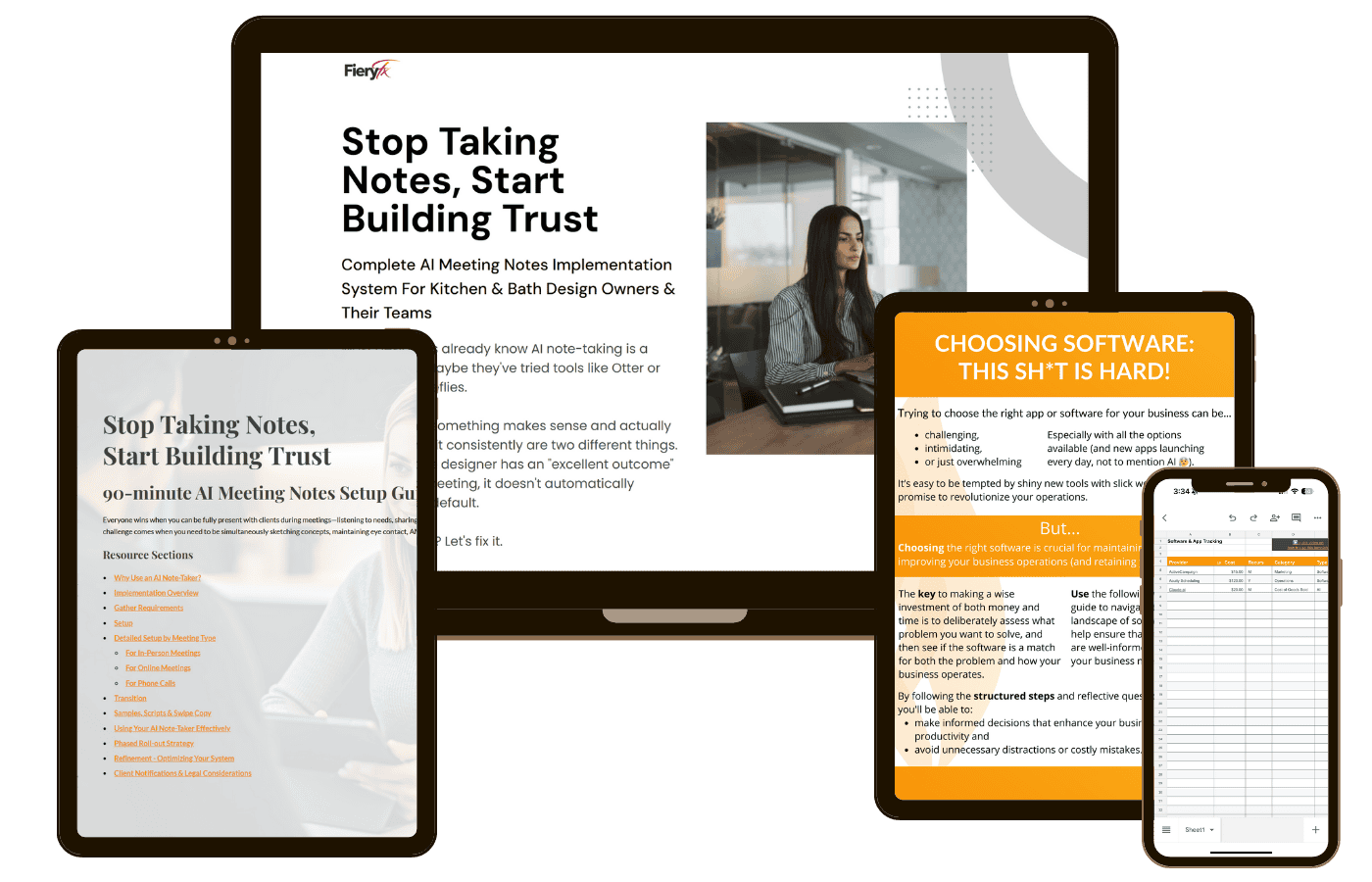
Ready to take your communication systems to the next level? Our AI Meeting Notes Implementation Guide shows you how to extend centralized intelligence beyond email to capture comprehensive meeting documentation automatically—the natural next step after mastering CRM email integration.
Want to explore more strategies for business systems and operational efficiency? Subscribe to the Elevated podcast for practical frameworks you can implement immediately. New episodes deliver actionable insights for building better businesses.
Prefer video content? Subscribe to our YouTube channel where we break down complex business concepts into clear, step-by-step guidance.